Speeding along Toronto’s Parkside Drive has surged more than 200 per cent following the Ford government’s removal of its automated speed enforcement program, community advocates say.
The group Safe Parkside says newly analyzed data from the City of Toronto shows a “dramatic and immediate spike in speeding” following the removal of the cameras in November, calling the trend “disappointing, as it is predictable.”
“Today marks exactly 6 months since speed cameras were banned across Ontario,” the group wrote in an email to CTV News Toronto.
“January to April 2026 saw a 235 per cent increase in the number of vehicles travelling 60+ km/h on Parkside Drive when compared to the same time period in 2025 when the Parkside Drive speed camera was keeping a watchful eye over the street.”
Safe Parkside says the figures come from a city “Watch Your Speed” sign installed a few metres south of the former camera location.
That camera continues to record the speed of vehicles alongside Parkside Drive and that data is posted publicly by the City of Toronto. However, no fines are issued.
‘We’re going backwards’
Faraz Gholizadeh, a local resident and the co-chair of Safe Parkside, reiterated in an interview with CP24 that the recent figures were discouraging.
“It’s entirely predictable that speeds would go up when you eliminate a safety feature as effective as a speed camera. So, it’s not surprising what has happened. The most surprising part is that it’s through the act of our premier that we’re in this position,” Gholizadeh said.
The Ontario government banned speed cameras last year, which Premier Doug Ford called “a cash grab.” The government replaced the cameras with “alternative traffic-calming measures,” such as speed bumps, speed cushions and roundabouts, as well as enhanced signage and education campaigns.
“It’s unfortunate that the premier started using the cash grab narrative for something that has been proven to slow speeds, to make things safer,” Gholizadeh said. “It’s a lot of disbelief that we’re in this position, after all these years of advocacy, that the only safety feature Parkside has ever had is now gone, and we’re seeing the consequences of it.”
Gholizadeh expressed concerns that Parkside will see more speeding unless effective measures from the provincial and municipal levels are implemented to curb the issue.
“That’s been Parkside’s history: nothing gets done, and the crashes just keep coming,” he said.
Gholizadeh said residents have reached out to the province, but they have not gotten any response.
“It seems like we’re going backwards, which is really disappointing, and it will only lead to one outcome, and that’s a tragic one,” he added.
In a statement to CP24, the Ontario Ministry of Transportation claimed that, despite the speed camera on Parkside Drive issuing 70,000 tickets over its time, “more and more drivers” broke the law and that speeding did not decrease.
“We are putting in place tangible measures to slow down drivers using speed bumps and roundabouts that actually protect children and families, supported by $210 million in funding to all impacted municipalities including Toronto,” the statement said.
A look back at the vandalism
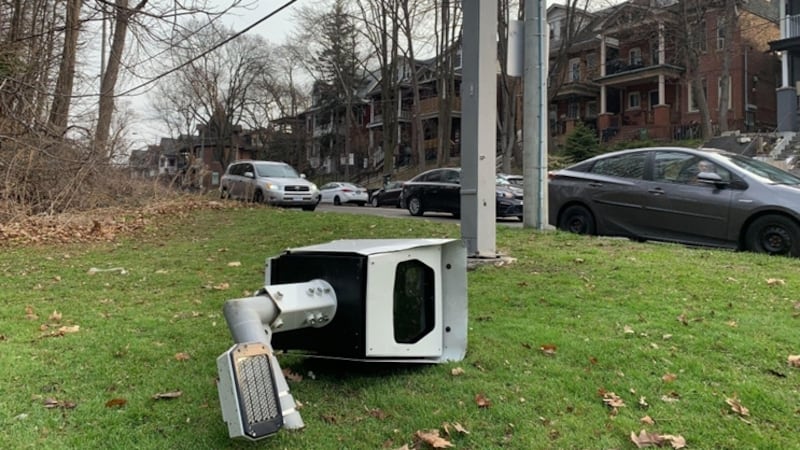
The Parkside Drive speed camera was one of the most vandalized devices in the city before the entire program was halted. In 2025, the camera was cut down a record seven times in less than a year.
At one point, CTV News obtained and released footage of vandals cutting down the device.
To this day, no arrests have ever been made in the multiple incidents.
Other occurrences of vandalism on Parkside involved the camera being cut down and dragged into the park, where it was later found in a pond.

Millions in fines
Safe Parkside says the final tally from the now-removed camera included 70,243 speeding tickets, an estimated $7.5 million in fines and a top recorded speed of 154 km/h in the posted 40 km/h zone.
Gholizadeh has previously told CP24 that the problem is centred around road design mixed with poor driver behaviour.
“When you design a street where everything’s geared towards motorists, you’re going to have speeding problems. To fix that, you need to reallocate the road space,” he said.
When speed cameras were in effect, at least one driver was once clocked going four times the limit.
With files from Joshua Freeman

