One in four kids in Toronto is experiencing poverty, as some family incomes in the city fall increasingly below the poverty line, a new report has found.
Released on Tuesday, Advancing the Promise for Toronto’s Children: Child and Family Poverty Report Card, Toronto 2026, analyzed the latest taxfiler data from 2023, which is the third consecutive year that poverty has grown and deepened in the city. It also drew on 2020 income data from the 2021 Census and related research.
Published by non-profit Social Planning Toronto (SPT), the 108-page report looked at child poverty trends, progress made to date, and actions needed to “reverse course,” its authors said.
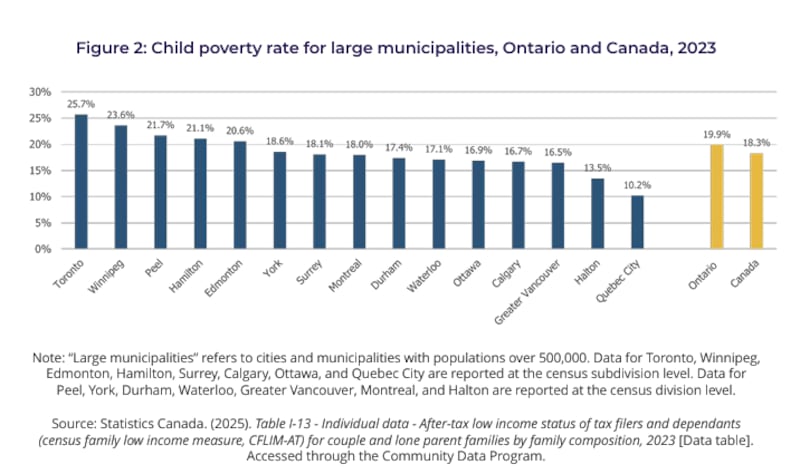
Including specific analysis for each of Toronto’s 25 wards, it found that between 2022 and 2023, child and family poverty went up by 0.4 percentage points in Toronto to 25.7 per cent.
This increase mirrors the Ontario average, however it is twice as high as the national increase of 0.2 percentage points.
“While this increase may appear modest, it represents approximately 1,800 more children who have fallen into poverty,” SPT said in an executive summary.
“At the same time, the depth of poverty has increased for all low-income family types, making it more challenging to meet their basic needs.”
Further, the report confirms Toronto’s “unfortunate distinction as Canada’s child and family poverty capital” as the city’s rate is the highest among the country’s large urban centres, a full two percentage points above Winnipeg, which came in second place at 23.6 per cent.
The Region of Peel rounded out the top three with 21.7 per cent.
Where child poverty is highest in Toronto
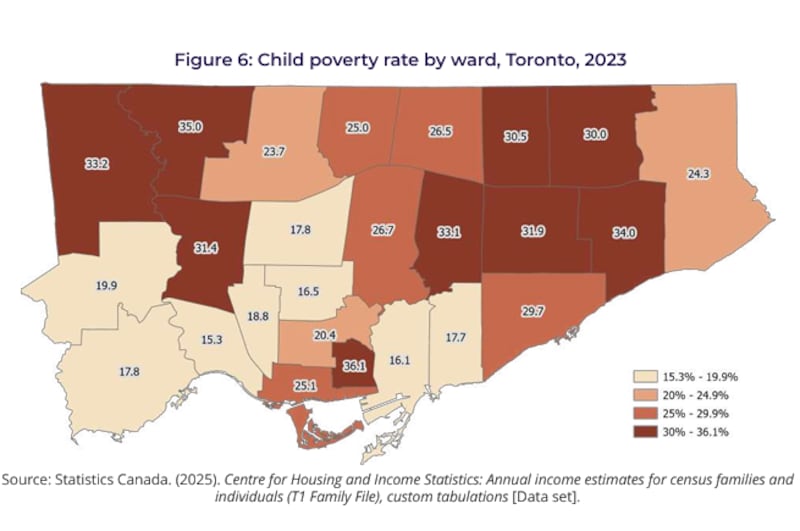
While child poverty exists across the city, it is especially prevalent in Scarborough and throughout the downtown core, the report indicated.
Nine of Toronto’s 25 wards had a child poverty rate of 30 per cent or more, with Toronto Centre topping the list at 36.1 per cent, followed by Humber River—Black Creek at 35.0 per cent, and Scarborough—Guildwood at 34 per cent.
The highest rate of child poverty recorded at the wider census tract level reached 61.3 per cent in Don Valley West.
The report also found between 2022 and 2023, child poverty rates increased in 18 of Toronto’s 25 wards, especially in Etobicoke Centre by 1.3 percentage points from 18.6 per cent to 19.9 percent, followed by Don Valley East, which is up 1.2 percentage points to 33.1 per cent, and Don Valley West and Humber River—Black Creek, which both went up by 1.1 percentage points to 26.7 per cent and 35.0 per cent, respectively.
Who is most affected by child poverty
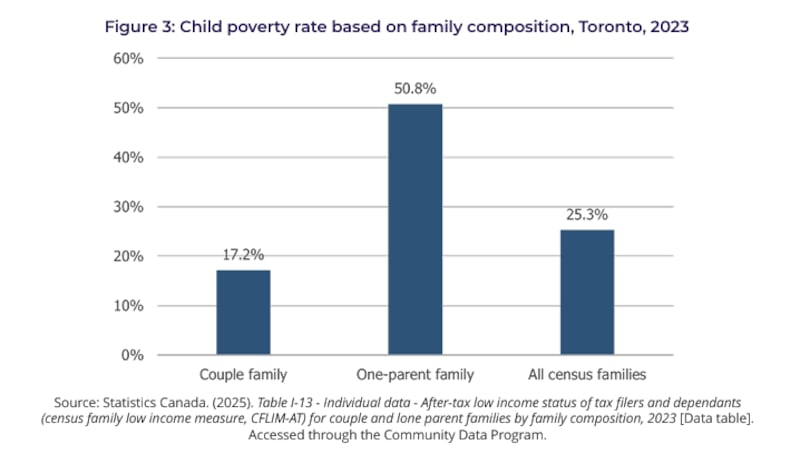
Child and family poverty in Toronto is especially prevalent in one-parent families, with half living in poverty.
According to the report, single-parent families with two kids in that bracket have a median after-tax family income $16,899 below the poverty line, while those with one child are $15,155 below the poverty line.
Analysis from 2021 Census data also showed that Indigenous (20.4 per cent), racialized (17.8 per cent), immigrant (21 per cent), and newcomer (38.1 per cent) children as well as those in non-permanent resident households (42.6 per cent) “face disproportionately high rates of poverty.”
‘Disparities reflect long-standing systemic inequities’
“These disparities reflect long-standing systemic inequities, including discrimination in employment, housing, and access to services, which shape families’ economic opportunities and stability,” the report’s executive summary stated.
These inequities, it says, are driven by the rising cost of living, notably housing, inadequate income supports, high unemployment rates, barriers to stable and well-paying employment, economic growth that has not benefitted everyone, gender-based violence, and limited access to affordable child care.
The impacts of these conditions are lasting, they added, and affect children’s health, education, and long-term opportunities, “potentially reinforcing cycles of disadvantage across generations.”
More government support needed: SPT
To address child/family poverty, SPT outlined three approaches: ensuring livable incomes and inclusive economic development practices; implementing a rights-based approach to basic needs of affordability; and renewing the focus on poverty reduction and systemic inequality.
It goes on to say that while municipal initiatives provide critical support, income supports and broad-scale investments in social infrastructure are key.
“The most important policy levers to address these challenges sit with the provincial and federal governments,” Jin Huh, the organization’s executive director, said in a news release.
“The City of Toronto has introduced and expanded some really great poverty reduction initiatives in recent years—including TTC fare capping, an expansion of the student nutrition program so it reaches all 330,000 students across Toronto schools this year, supports for renters, and creating purpose-built affordable and supportive housing—but responding to this crisis will require income supports and investments in social infrastructure at a scale only senior levels of government can provide.”
The organization is encouraging candidates in the upcoming municipal election to “present clear visions for reducing poverty and strengthening social infrastructure, and inviting residents to consider these issues as they evaluate those platforms.”
Some of the concrete ways to make a difference, SPT says, are by increasing the supply of public and not-for-profit child care spaces in high-poverty neighbourhoods, developing measurable targets on poverty reduction, and committing to reducing child poverty through coordinated action with senior orders of government.
‘Troubling trends’ but solutions available
Sharma Queiser, a researcher and policy analyst with Social Planning Toronto and one of the report’s authors, said the findings are “troubling trends,” but solutions are available.
“Between 2015 and 2020, child poverty rates in Toronto steadily declined, coinciding with the Federal Government’s introduction of the Canada Child Benefit in 2016. Unfortunately, without further investments, we’re losing that progress,” she said.

