The City of Mississauga is attempting to expropriate two houses in the municipality’s Port Credit neighbourhood after the property saw hundreds of visits from police, firefighters, and bylaw officers over the past year-and-a-half.
It is a move that one expert says is a somewhat novel application of expropriation laws more commonly used to clear the way for the development of major infrastructure projects, like subways.
But Mississauga city councillor Stephen Dasko told CP24 last month that the city has exhausted all other options to deal with the slew of complaints at the properties over the past 18 months.
The homes, located at 34 and 36 Peter Street, are across the street from Riverside Public School and a few doors down from the Mississauga Long Term Care Facility, located in the area of Mississauga and Lakeshore roads.
If the expropriation is successful, the plan for the homes is to demolish them and turn the properties into a parking lot to address a parking deficit in the area, Dasko said in an interview with CP24.com on Oct. 7.
In a written statement, Peel Regional Police said between January 2025 and August 2026, officers responded to “hundreds of calls for service relating to the two properties.”
The calls, they said, involved “disturbances, assaults, weapons, thefts, and drug-related activity.”
“These incidents resulted in more than 50 arrests, with numerous charges laid,” police said in an email to CP24.
Police noted that there has been “enhanced officer presence in the area” as a result and officers have attended multiple community meetings to address the “significant public safety concerns.”
Records indicate that 34 Peter Street North is owned by 2855277 Ontario Inc. and 36 Peter Street North is owned by 2855270 Ontario Inc.
In a statement, Ava Kanner, a lawyer representing the owners of the properties, said her clients have “made every effort to resolve the situation at 34 and 36 Peter Street for some time, without success.”
“We are currently working with the City of Mississauga on a solution,” she said in an email to CP24.
Dasko said at one point, as many as two dozen people appeared to be living at the two homes, including people who were sleeping in the backyard.
He said that he believes numerous incidents in the wider community could be linked back to the properties.
“It’s truly lawlessness that’s going on there, from countless stolen items that have ended up on the property that people have come across,” Dasko said.
“There is local stores that have been broken into numerous times, people walking out with goods… What we’ve had is a lot of drug activity that’s been going on there.”
He attempts have been made to bring the properties into compliance with city bylaws and fire code regulations.
“All of our city departments, quite frankly, are beside themselves, (the) region as well in terms of how to provide supports,” he said.
“Every single department at both levels, Peel Regional Police…they’re there on a daily basis, proactively and actively.”
Stephanie Howell, a parent of a child who attends the elementary school across the street, said last year, the school was placed under two hold-and-secure orders as a result of activity at the homes, including one shortly before the holiday break in December.
She said during that time, people were not allowed to enter or leave the school.
“We did have one of our parents who her child has special needs. She had set up a meeting with somebody from McMaster University. They were coming in to do an assessment with her daughter, and they couldn’t get into the school,” she said.
“Being a school that has so many special needs children, we have a lot of people coming in and out all day. So we have social workers, EAs, assistants and doctors, things like that, and in a hold-and-secure, they’re not able to access (the school) so the children inside don’t necessarily have that attention that they’re going to need in those moments.”
In a letter viewed by CP24, the school cited “a potential threat in the community” as the reason for both hold-and-secure incidents on December 17 and June 22, but police did not confirm if the threats involved individuals connected to the two residences.
Images Howell captured on the day of the first hold-and-secure show several police cruisers and officers out on the street near the two Peter Street homes.
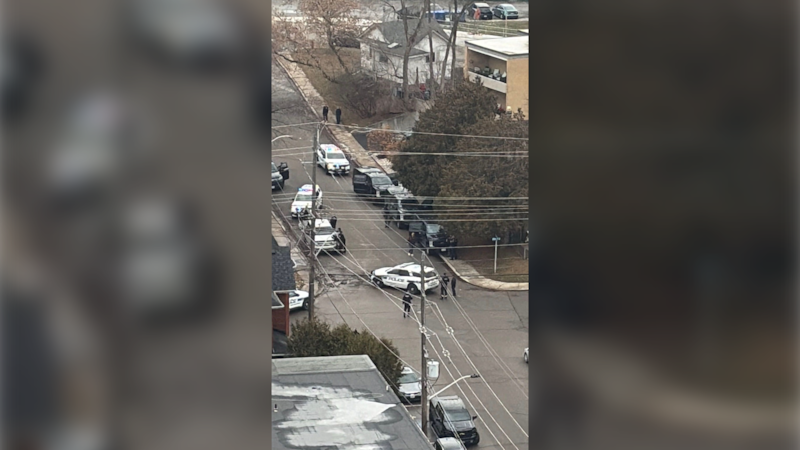
One resident of the neighbourhood, Tom Jonaitis, said it is not uncommon to see trash piled up at the homes and police cars and ambulances are there frequently. He said neighbours often hear fights break out at the properties and screaming can sometimes be heard in the middle of the night.
‘No end in sight’
At a public meeting about the properties in August, Jonaitis estimated that more than 100 community members showed up to share their concerns.
“Everyone’s been doing their part as best they can, but there’s no end in sight. There’s no solution,” he said.
Domenic Tudino, the director of strategic legal projects for the City of Mississauga, said the municipality considered multiple options on how to approach the homes, including a closing order under section 447.1 of the Municipal Act.
In a statement, he said the city concluded that it was not the “best remedy” to get a timely resolution to the issue, and further delay would “only serve to increase the frustration being felt within the community.”
A closing order, he noted, would require the consent of the chief of police and then an application would need to be made to the Attorney General.
“The Attorney General may either support the application or oppose it and take steps to terminate the application,” he said in an emailed statement to CP24.
“Secondly, securing a court date before a judge in the Superior Court may take as long as 12 months with the current backlog in litigation proceedings. There’s also the possibility of the owner’s lawyer asking for an adjournment of the hearing (for any number of reasons) only days before the hearing date.”
He added that they reviewed a recent case involving a closing order in St. Catharines before making their decision.
Tudino noted that in that case, only a 12-month closing order was granted rather than a full two-year closure.
“All of this was discussed and debated internally, and the unanimous conclusion was to proceed with an expropriation.”
- How to set CP24 as your preferred source on Google
- How to set CTV News as your preferred source on Google
Barry Cox, the lawyer who represented the City of St. Catharines in that closing order application, told CP24 that municipalities must meet a “fairly high bar” for the property to be closed.
He said after being retained, he tried to find similar cases where closing orders were applied to residential properties but found only one that applied.
“With one exception, all of the reported cases I could find dealing with closing orders were sort of commercial properties, things like rendering plants, landfills. We’re talking noise, we’re talking bad odors, that kind of thing, industrial things,” he said.
He said his job was to meet with Niagara Regional Police, members of the fire department, Niagara paramedics, local councillors, surrounding neighbours, and obtain evidence from them and document their experiences to present to the court.
“The matter in which I was involved was somewhat unique insofar as it dealt with a private residence, and we were actually making the argument to the court that things have gone so far at this property that we are asking to treat the owner of the property like a trespasser in their own home,” he said.
Ultimately, the closing order was made for a period of one year.
“No one uses it for anything, it’s closed up… and presumably that’s long enough for whatever activity is going on there that’s at issue to come to an end and for the people who are carrying on that activity to go elsewhere,” he said.
“An expropriation is, it’s a different thing.”
Expropriation ‘not a common’ tool
Ajay Gajaria, a municipal and land use planning lawyer and partner at Aird & Berlis, said it is not “unheard of” to use expropriation is this type of case.
“Expropriation has been used in the past in other municipalities, including in Toronto, for salvage yards and other issues of public nuisance,” he said.
“It is a tool that has been used before by municipalities to deal with nuisance, but it is not common.”
He noted that the municipality’s first step in the process is to send notice to the registered owners of the intention to expropriate.
“The owners have the right to request a hearing of necessity at the Ontario Land Tribunal to determine if the proposed taking is fair, sound, and reasonably necessary for the purpose of the expropriating authority,” Gajaria said.
“That process results in a recommendation to the approval authority, who… is counsel of the municipality, and then the counsel of the municipality as the approval authority can make the determination if they intend to vary, withdraw, or proceed with the expropriation.”
He added that most disputes arise when determining how much a property is worth.
“An owner who has been disposed of their property is entitled to receive the amount of money that the property is worth as though it had been a willing buyer, willing seller process for market value,” he said.
“So most disputes about expropriation largely sit in the realm of how much the given property is worth, and Mississauga, as the expropriating authority, is responsible for paying the fair market value of how much the property is worth.”
Disputes, he said, are adjudicated by the Ontario Land Tribunal and that can be appealed up to a divisional court and the Court of Appeal, and then ultimately the Supreme Court of Canada “in the very unusual” circumstance that it makes it to that level.
The exact timeline for when expropriation cases are settled varies but Gajaria said it may not be faster than a closure order.
“Public authorities who I have acted for have not viewed expropriation as a fast process or a painless process. It is a great deal of process involved in an expropriation, but the same can be said about a closure order,” he noted.
“It’s certainly more costly to do an expropriation… you’re essentially buying the value of the property, so it is more expensive than a closure and if there’s a dispute in terms of how much that is worth, that is adjudicated.”
Tudino said the municipality hopes to come to a “mutually satisfactory settlement” in under 12 months.
He could not say how much they anticipate it will cost to expropriate the two properties if they can proceed.
“The cost of an expropriation is generally determined by the opinion of a professional property appraiser,” his statement read.
“At the moment, City staff are in the process of retaining an appraiser to assist the city.”
Any tenants that currently reside at the property are entitled to notice under the Expropriations Act, the city said, and would have the right to “advance claims for compensation against the city.”
“However, as of today, the city has not heard from anyone claiming to be a tenant,” a spokesperson for the city said.
The spokesperson added that the lawyer for the owners has requested a hearing of necessity. A date for the hearing has not yet been set.

