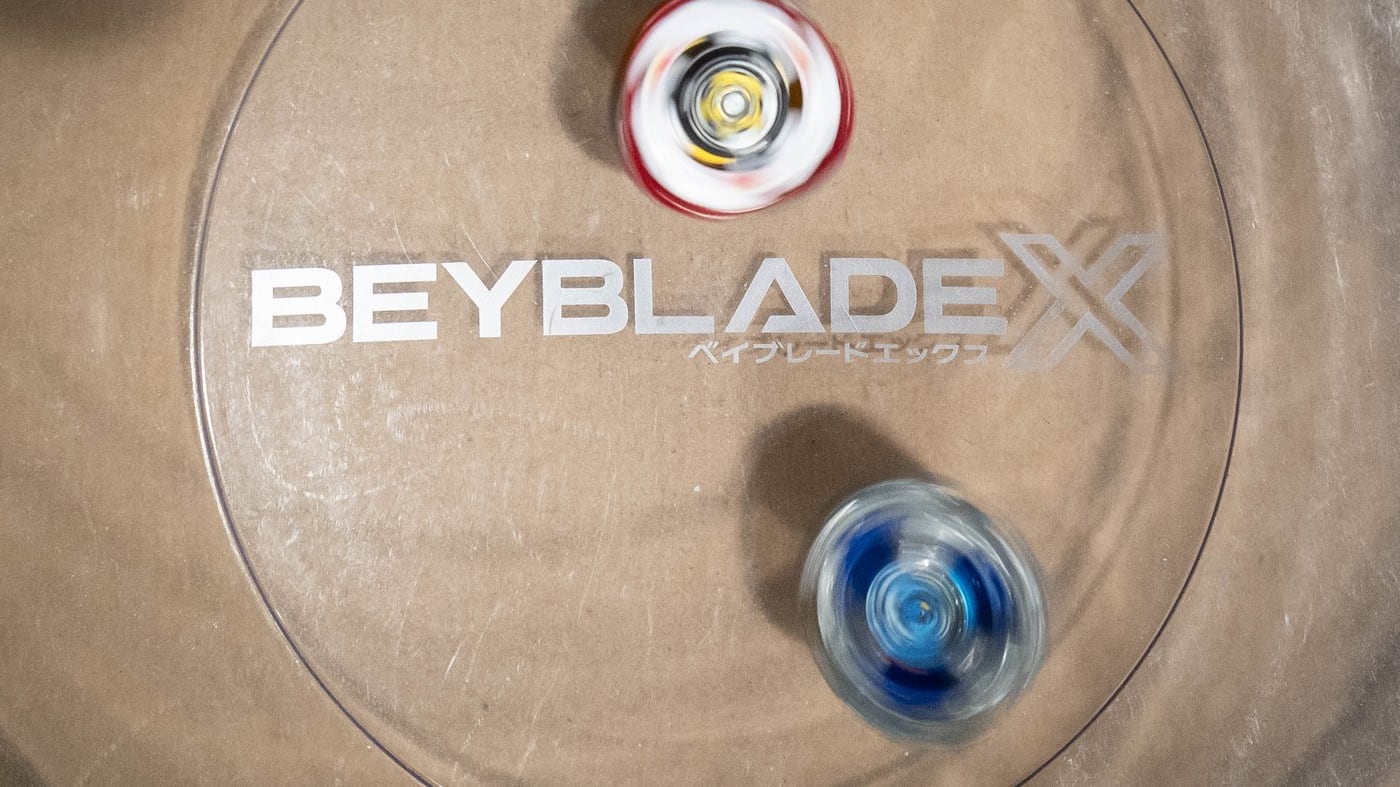
RICHMOND — At Imperial Hobbies in Richmond, B.C., the air is filled with the sounds of battle.
“Three, two, one — shoot!”
The combatants unleash their weapons, setting off high-pitched whirring, and clashes of plastic and metal.
Beyblades — the spinning battle-top craze that whirled through playgrounds around the world in the early 2000s — are back. This time, it’s not just kids — adults including millennials who grew up with Beyblades a quarter-century ago are at the forefront of the new fandom, as they attempt to master the physics at the core of the toys.
Justin Tan, a FedEx courier, was among about 40 competitors at a Beyblade tournament hosted by Imperial Hobbies on a recent Sunday, all male, ranging in age from teens to over 60.
“For me, this is actually a good stress remover. You know, working hard every day, Monday to Saturday, and you’re just so tired,” said Tan, 35, who has joined almost 100 tournaments over the last two years.
He placed a set of three Beyblades in front of him before gently selecting one, and striking a ninja pose. At the command of the judge, he and his opponent pulled their rip cords to launch their Beyblades into the Beystadium, the bowl-shaped mini arena where tops crash into each other until the winner is decided by stopping, ejecting or even destroying their opponent.
Launched in Japan in 1999 by Takara Tomy, the first wave of Beyblades inspired a manga, anime series and a movie. Hasbro licenses the toys in North America, and Hasbro Canada spokeswoman Marisa Pedetella said they were experiencing a resurgence “driven largely by nostalgia and innovation.”
Pedetella said Beyblades have always been a “cyclical, wave-driven brand,” with new generations launching roughly every four years.
“The latest relaunch began in 2023 with Beyblade X, and we are now in year three, historically the biggest year in any given cycle,” said Pedetella.
Thirty-year-old Colton Derycke from Cumberland on Vancouver Island puts his fandom in more wistful terms.
He described walking though a Walmart with his young son a few years ago and being struck by a “crazy core memory” of seeing Beyblades, a childhood obsession in the “O.G. Beyblade days.”
“Whoa, Beyblade is back? This is insane,” he recalled thinking.
Derycke went on to start the Vancouver Island Beyblade League about two years ago. It now has 120 members.
He likened the enduring appeal of Beyblades to Pokemon cards. “They’re capturing some of that nostalgia as well,” said Derycke, “We’ve caught a bunch of people just like, randomly meeting up at a park and playing Beyblades.… Just letting it rip. It’s so nostalgic."
Pedetella would not reveal Beyblade sales data, but said the toys have “strong representation” across Canada, with fan communities organizing tournaments “driven purely by passion and competitive spirit.”
Hasbro’s 2025 annual report lists Beyblades sales growth as a highlight, while the latest earnings report for investors says that growth has continued in the first quarter of 2026.
Vancouver-born Jack Lee started hosting competitions in Metro Vancouver in 2022, initially renting out space at Lougheed Mall in Burnaby with friends. He’s watched the popularity of Beyblades explode recently.
“We used to have 100 events a year in North America, and now it’s like, across North America we have 100 events a month,” said Lee, who frequently travels to Asia for tournaments.
He said many players in B.C. used to play with Beyblades in Hong Kong and the Philippines, retaining their childhood hobby after moving to Canada.
“I remember talking with Hong Kong friends, like, when our parents play mah-jong on the weekend — this is our mah-jong,” chuckled Lee.
He also attributed the spike in popularity to the latest iteration of the Beyblade franchise, known as Beyblade X, which has fan-pleasing features such as a new mechanism in the Beystadium that propels tops to “xtreme” speeds.
Hanson Ho, 22, has been hosting tournaments almost weekly in Metro Vancouver for about a year. He moved from Hong Kong to Vancouver at 10, bringing his love for Beyblades, an obsession since he was five.
“When I was little, I asked my parents to host a mini tournament for me, inviting all my friends, and some other people who just lived near my place, so we could rent a room and then just play for one day. It was very nice,” said Ho. “I thought it was a big community thing.”
Ho, who goes by nickname “Pulled Pork” in Metro Vancouver’s Beyblade community, said the scene in Hong Kong is huge, and he travelled there about a year ago to join a tournament.
Back at Imperial Hobbies, Simon Supronimo from Seattle stood out with his pink-dyed hair and two broken Beyblades hanging as pendants on a necklace.
He has been attending tournaments in Metro Vancouver for the past couple of years, where the prominence of Beyblades was like seeing a childhood dream come true.
“I remember as a kid, I would watch the anime, and I was like, man, these people are going out battling each other in tournaments — I wish that were a real thing. And then it became a real thing when I was an adult,” said Supronimo.
“I was like, I have to do this. This is my calling. My inner child was like, ‘Go out there,’ and I was like, ‘Yes, I will.’”
Paul Stouse, 66, from Coquitlam, B.C., said he was “probably the oldest one” at the Imperial Hobbies tournament. He started getting into Beyblades about two months ago, thanks to his partner, Diego Gonzalez.
“It’s nice to meet the community and meet new people. So, that makes it fun,” said Stouse.
Derycke said he sometimes brings his four-year-old son Rogan to the tournaments he organizes on Vancouver Island, and has been passing on his love for Beyblades.
“It’s a good way to get energy out,” said Derycke. “It’s better than the iPad.”
This report by The Canadian Press was first published May 28, 2026.
Nono Shen, The Canadian Press

