
A Saskatoon drug dealer was in court last month calling on a judge to overturn an order that would allow the province to sell personal property seized during his arrest.
That’s because, technically, Mahamed Osman already had a chance to petition the province to get his things back. He just missed it, because he was in jail.
In fact, Osman had been in custody since his initial arrest on Oct. 6, 2024, when Saskatoon police raided his home at 118 Pawlychenko Lane and seized an assortment of property and he was charged with the trafficking of kilo-quantities of methamphetamine.
In line with the terms of the Seizure of Criminal Property Act (SCPA), on Feb. 4, 2025,a director from the provincial office sent a notice of forfeiture proceedings by registered mail to Osman’s last known address on Pawlychenko Lane.
But Osman no longer lived at that residence and had been behind bars since the arrest, when his stuff was seized.
Since he missed the 10-day window to respond, he was deemed to have forfeit his property. It was turned over to the province to be sold – one of the ways the provincial government tries to offset the costs associated with crime, and the growing expenses of enforcement.
It’s not clear what property Osman wanted returned, but in a press release following the arrest, the Saskatoon police list seven vehicles that were seized as evidence in the investigation, including a 2019 Land Rover, a 2013 Honda Pilot, 2015 Dodge Durango, 2013 Infiniti Jx35, 2022 Dodge Ram, 2016 Audi RS7 and a 2011 Ford F250.
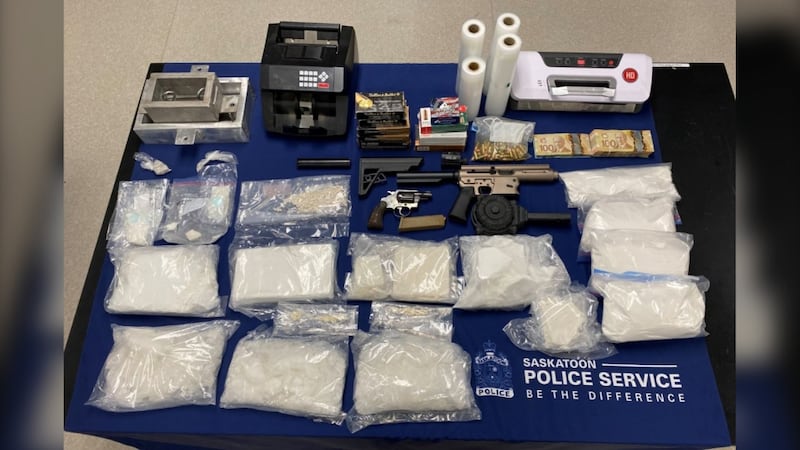
That’s in addition to about four kilos of cocaine and nearly three kilos of meth,$16,000 in cash, kilos of buffing agent, a carbine rifle, a prohibited Colt 38 revolver, ammunition, a cocaine press, money counter, scales, vacuum sealer and cell phones.
According to the account of Saskatoon Court of King’s Bench Justice Colin Clackson, there are two methods for serving someone notice under the SCPA: in person, or by registered mail sent to a last known address provided by police.
“In this case, the Director chose the latter option,” Clackson wrote in a decision last month, after Osman and his lawyer Nicholas Stooshinoff filed a lawsuit seeking to have the forfeiture proceedings declared invalid.
“Mr. Osman does not complain that the Director failed to comply with the service requirements … but rather that, due to Mr. Osman’s particular circumstances, the Director’s compliance with the Act was ineffective in bringing the notice to his attention.”
Clackson says Osman didn’t dispute the Feb. 4 notice of forfeiture was sent to his last known address prior to his arrest, but asserted it was not his primary mailing address.
On March 3, the Saskatoon Police Service received a notice confirming Osman’s property had been forfeit and could be released to the province.
It’s not clear from the record when it came to Osman’s attention, but it was sometime before Sept. 3, when it was the subject of an email exchange between Stooshinoff and the Crown prosecutor assigned to the trafficking case.
He filed the application covered here in early December.
‘An absurdity concern’
In his application, Stooshinoff called on the judge to apply a legal regulation from the King’s Bench rules, Rule 12-1, which allows a judge some flexibility in determining whether legal documents were properly served.
Under Rule 12-1, a judge can set aside consequences for failing to respond if they were received late, or to extend a deadline if it will help avoid a miscarriage of justice.
Stooshinoff put forward two arguments for Rule 12-1 in this case.
First, he contended no other provision of the SCPA explicitly ousts the operation of the King’s Bench Rules.
Second, he argued that to conclude otherwise would result in an absurdity, “permitting the Director to deprive interested persons of their personal property without due process and permitting the Director to shelter itself from judicial scrutiny with respect to improper notice.”
Clackson wasn’t convinced.
He says the King’s Bench rule is supposed to guide the court when the legislation is unclear, not the other way around.
The SCPA has specific rules about how to properly serve notice, Clackson writes. Those rules just happen to be indifferent as to whether they effectively get the attention of their target audience.
And the “absurdity concern” is moot, says Clackson, because the law allows an interested party to apply to set aside a forfeiture within six months, and Osman did not miss that window. Those proceedings are on the schedule.
Clackson tried to imagine what the legislature intended when they passed the SCPA, and how they would feel about a judge overruling the provisions set out in the forfeiture law in a way that helped a convicted drug trafficker get his belongings back.
That, it might be said, would be absurd.
RELATED:

