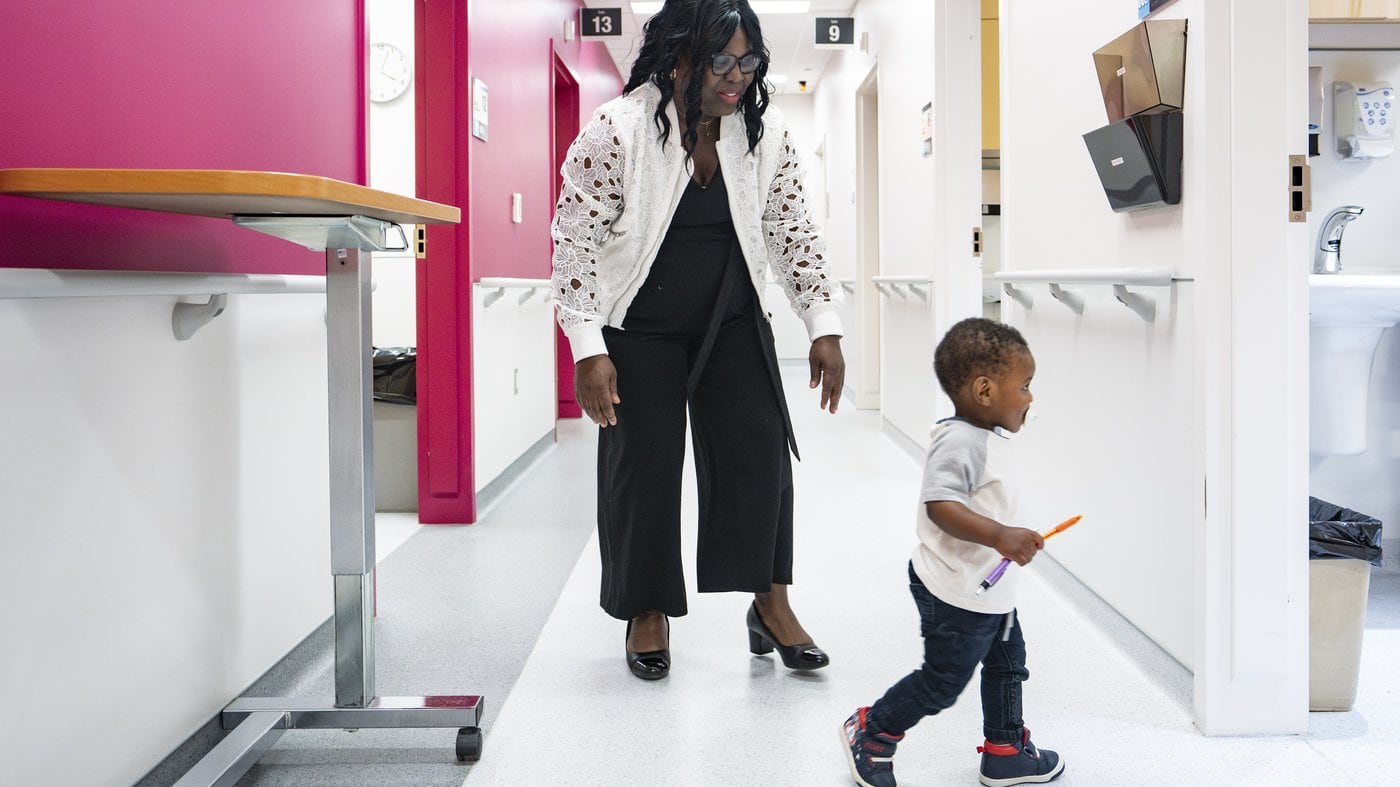
MONTREAL — On May 15, 2024, Habalet Andrée Loblegnon learned she was pregnant for the fourth time. Two weeks later, she was diagnosed with stage three breast cancer.
She had noticed a lump under her right armpit during her third pregnancy, but her doctor said at the time there was no cause for concern. It wasn’t until the 41-year-old’s fourth pregnancy that she received the diagnosis — and was immediately faced with a pressing question.
Her decision was without hesitation: she would carry the baby to term, even though it meant undergoing chemotherapy while pregnant. When she returned home from the doctor to her husband and three children, she said she broke down.
Loblegnon’s situation is rare — less than 0.1 per cent of pregnant women in Canada receive a cancer diagnosis — and requires a highly specialized approach to maintain the health of both mother and baby, says Claude-Émilie Jacob, an obstetrician-gynecologist at the Montreal hospital centre known as the CHUM.
In a recent interview, Jacob said she decided to open a clinic dedicated to pregnant cancer patients five year ago when she saw how difficult it was for these women to navigate the health-care system.
“We’re helping them in both the best moment of their life and the worst,’’ Jacob said.
Pregnant women with cancer can end up moving between multiple specialists — oncologists, surgeons, and obstetricians — each offering separate recommendations, Jacob said. These women end up feeling like they are being given “different pieces of a puzzle without seeing the full image.”
The clinic’s goal, Jacob explained, is to centralize decision-making so patients no longer have to co-ordinate their own care while coping with cancer and pregnancy simultaneously. “We want to put the puzzle together so the patient doesn’t have to,” she said.
The clinic operates out of the obstetrics floor at the CHUM. Whenever a patient is referred to her, Jacob assembles a multidisciplinary team that can include surgeons, oncologists, pharmacists, neonatologists and high-risk pregnancy specialists. Together, they tailor treatment timelines around both cancer progression and fetal development.
The clinic has also begun expanding its research activities over the last year, while other Quebec hospitals are increasingly turning to the CHUM team for guidance with their own pregnant cancer patients, Jacob said.
After Loblegnon’s diagnosis at a hospital in Longueuil, Que., on Montreal’s South Shore, she said she was immediately transferred to the CHUM. She met with Jacob and her team, who began thinking about the best approach to treat her.
One of the biggest challenges is timing treatment around a pregnancy, said oncologic surgeon Rami Younan, who operated on Loblegnon.
Chemotherapy drugs and dosages are difference for pregnant women compared with other patients. Many cancer drugs risk causing birth defects or even the loss of the fetus, says Guy Soulières, a hematologist-oncologist and spokesperson for the Canadian Cancer Society.
Because of that risk, chemotherapy is avoided during the first 13 weeks of pregnancy, when fetal organs are forming, Jacob said.
Loblegnon began treatment after 13 weeks, in July 2024; weekly chemotherapy sessions left her exhausted. Her care required constant communication between multiple teams, said Younan. Treatment schedules, monitoring, and delivery planning all had to be carefully aligned to protect both mother and baby.
“The co-ordination was perfect,” he said.
He added that even the timing of her caesarean section had to be carefully planned. Chemotherapy weakens the immune system, increasing the risk of infection and complications during surgery, he said. This means delivery had to be scheduled at a moment that balanced both Loblegnon’s recovery and her baby’s safety.
A month after giving birth, Loblegnon underwent a full mastectomy.
Because cases like Loblegnon’s are so rare, doctors face a lack of large-scale research to guide treatment. “When we have less than one per cent of cases, we can’t obtain meaningful numbers,” Soulières said in an interview.
Doctors say the clinic’s centralized model is especially important because pregnant women with cancer are so uncommon. By concentrating patients in one specialized centre, the CHUM can build expertise, compare outcomes and develop research that could eventually help shape treatment standards elsewhere.
Today, Loblegnon’s fourth child, Theo Jr., is one-and-a-half years old and in perfect health. During the interview, he moved around the room on his own, going from his mother’s arms to the laps of the two doctors who had saved her life.
‘’This is why we do our job," said Jacob, looking at Theo and his mother.
Charlotte Glorieux, The Canadian Press

