


OTTAWA -- Extreme polarization and consensus are dangerous and a better country can only be built through the “peaceful management” of our differences, Gov. Gen. Louise Arbour said Monday in her first speech as the King’s representative in Canada.
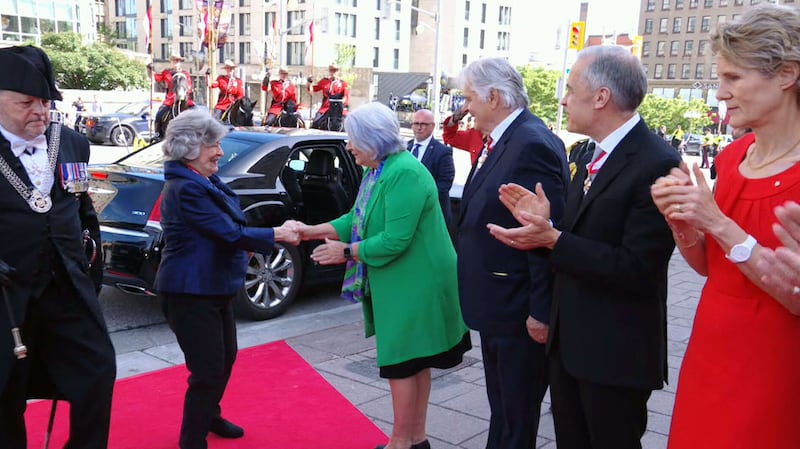
The former Supreme Court justice and international prosecutor was sworn in as Canada’s 31st Governor General in a ceremony filled with tradition, and with some of her own personal touches in the selection of music and the decision to travel to and from the event in a passenger vehicle, rather than a horse-drawn carriage.
Arbour’s speech also drew heavily from her own lived experiences as a francophone woman and jurist who also spent many years abroad as a prosecutor for the International Criminal Tribunals and the UN high commissioner for human rights.
She said our ability to coexist peacefully, despite our differences, is critical to maintaining a lawful, rules-based society.
“It is through our differences, and our fundamental right to express them, that we will nourish critical thinking, creativity and innovation,” Arbour said from the throne in the Senate chamber.
“It is through our differences that we will build a common future.”
Arbour, 79, said it’s important to protect the arenas where those debates take place, such as universities, the media, courtrooms, legislative spaces and the arts.
“This is what it means to live under the rule of law, in an open society like ours,” she said. “The purpose of law is not to restrain, but to construct a greater freedom for all.
Canadians, she said are self-deprecating in their humour, and hold humility in high regard.
“We don’t think we are perfect, but we believe we’re pretty well on the way there,” Arbour joked, drawing laughter from the audience.
The official duties of a governor general include serving as commander-in-chief of Canada -- which includes awarding military honours -- swearing cabinet ministers into office, proroguing and dissolving Parliament, making appointments on the prime minister’s advice and granting Royal Assent to turn bills into law.
While the role is often seen as ceremonial, the office of the governor general links the House of Commons to the Crown and is critical to how Canada’s democracy functions. Arbour met last week with King Charles at Buckingham Palace.
Prime Minister Mark Carney said in his own speech that Arbour exemplifies the best of Canada.
“Canadians entrust the Governor General to defend our institutions, to uphold our core values of liberty, fairness, solidarity and sustainability, to represent our ambition to build a stronger, fairer country for all,” he said.
“These duties call for sound judgment, deep learning, and an unwavering commitment to the rule of law, the very principles on which our new Governor General, Her Excellency Louise Arbour, has built her exceptional career.”
While the ceremony is steeped in Westminster traditions, some of which predate Canada, Arbour spent part of her speech discussing one of the most portentous societal and technological shifts since the Industrial Revolution -- the rapid rise of artificial intelligence.
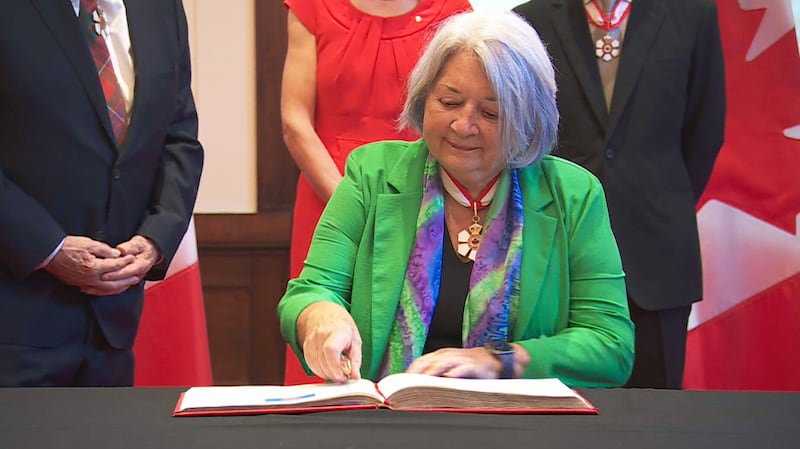
Arbour cautioned against overreliance on the technology. She said the convenience it offers should not lead anyone to overlook the “profound societal shifts” that are coming.
“With instant access to vast amounts of information, it’s very tempting to pay little attention to the reliability of sources. The lines between knowledge and belief, between truth and falsehood, between facts and assumptions are increasingly blurred,” she said.
“AI could be threatening not only the way we live and work, but also the control we exercise over our own destiny.”
She said the challenge must be met by strong institutions and a private sector that “upholds the standards of integrity that Canadians expect.”
NDP Leader Avi Lewis, who attended Arbour’s installation, said he sees some “daylight” between Arbour’s warnings on artificial intelligence and the government’s recently released AI strategy.
“She spoke about the legitimate fear of AI and of young people and their fears entering a world that seems designed to exclude them,” Lewis said Monday.
“We need to protect workers. We need incredibly strong guardrails and regulation in place, and the vast majority of Canadians agree that AI needs to be regulated.”
The government’s strategy talks about developing public education and trust around AI but doesn’t offer regulatory specifics.
A 21-gun salute was fired from canons set up nearby on Parliament Hill as Arbour ascended the throne of the Senate -- a symbol of the relationship between the Canadian Armed Forces and the viceregal office.
Following the ceremony, Arbour, two of her grandsons in tow, walked across the street to the National War Memorial, where she performed her first of what will be many inspections of the guard.
She shook hands along the way with onlookers at the fences set up around the Senate and memorial in downtown Ottawa.
Arbour also thanked outgoing governor general Mary Simon, Canada’s first Indigenous viceregal, for serving in the role through the COVID-19 pandemic and economic upheaval, and for showing Canadians that reconciliation is a lifelong exercise.
Simon received a standing ovation in the Senate.
Rideau Hall issued a statement on Simon’s behalf once the ceremony began. In it, she thanked Canadians and called on them to continue “building bridges of empathy and connection throughout our vast country.”
“I believe in the importance of strengthening relationships and deepening understanding among all peoples, Indigenous and non-Indigenous alike,” Simon wrote.
“Reconciliation belongs to all of us. It is not only about acknowledging the past, but also about shaping our shared future. It calls for us to share our stories, to learn from one another, and sometimes to have difficult but necessary conversations. This is how we move forward together, in dignity and equality.”
Arbour also touched on reconciliation in her speech when she said that Indigenous knowledge and tradition have been “long overlooked” and Canada needs to embrace a future “in which First Nations, Inuit and Metis people are no longer cast aside.”
Arbour played a role in the musical selections during the ceremony including a performance by francophone artist Sara Dufour of the song “La Reine” by Les Cowboys Fringants. The song is about a woman who puts her service to others ahead of her own personal challenges. Anglophone artist Tyler Shaw also performed “Like Me and You” by Raffi at the ceremony.
Chimwemwe Undi, Parliament’s poet laureate, read her poem “Reasons,” which she wrote for the ceremony. A French translation of the poem was read aloud by Koby Jean, a student from the Louise Arbour Elementary School in Ottawa.
By David Baxter and Catherine Morrison, The Canadian Press
With files from Dylan Robertson
This report by The Canadian Press was first published June 8, 2026.

