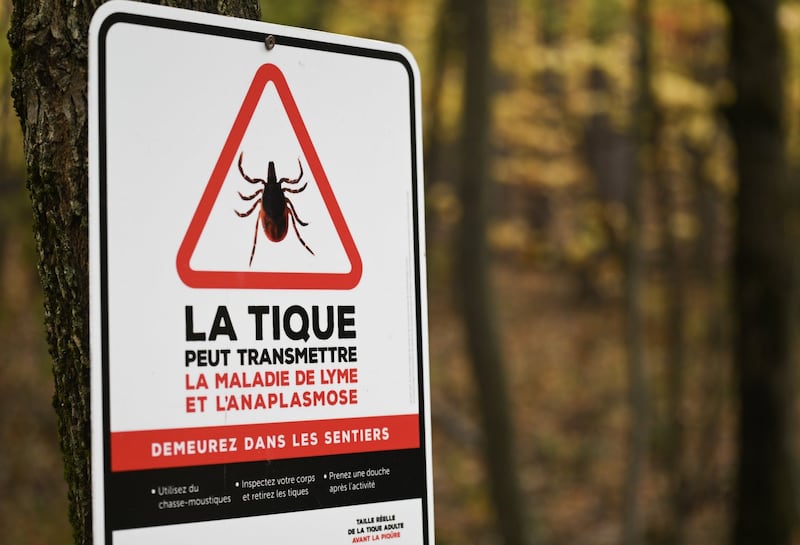
Tick reports are surging across Eastern Canada this year – and especially in Ontario. Driven by climate change, migratory birds, and expanding mice and deer populations, experts expect the troubling trend to continue well into the future, increasing the risk of serious tickborne illnesses like Lyme disease.
Data submitted to eTick.ca as of June 23 shows that confirmed tick reports are up 38.5 per cent in Canada so far this year compared to the same period in 2025.
Reports of blacklegged and western blacklegged ticks – the two species that carry Lyme disease – are also up by 35.2 per cent.
After suffering through a late-stage Lyme disease diagnosis in 2015, Justin Wood founded Geneticks, Canada’s first private tick testing lab.
“I expect this upward trend to continue every year in Canada for the foreseeable future,” Wood told CTVNews.ca from Uxbridge, Ont. “Climate change is the driver to this process.”
An uptick in reports
The uptick is largely being driven by Ontario, which was responsible for 52.9 per cent of all tick reports and 63.7 per cent of all blacklegged tick reports that were filed in the provinces between Jan. 1 and June 23, 2026. The 8,735 ticks reported in Ontario so far this year is a 50.2 per cent increase over the same period in 2025, while the 3,126 reports of blacklegged ticks is a staggering 72.8 per cent jump over the previous year.
The reports were made to eTick.ca, a free online platform for identifying ticks that was developed at Bishop’s University in Quebec. Since eTick.ca relies on user-submitted data, confirmed tick numbers likely represent only a small fraction of actual populations in Canada.
So far this year, tick reports are also up significantly in Manitoba (108.9 per cent), Alberta (71.5 per cent), Saskatchewan (53.2 per cent), Quebec (39.2 per cent) and New Brunswick (32.4 per cent). After Ontario, the most blacklegged or western blacklegged ticks were reported in Quebec (656), Nova Scotia (432), B.C. (427) and New Brunswick (128). Because disease-carrying ticks have largely not established themselves in Canada’s three northern territories, data from Yukon, N.W.T. and Nunavut was excluded from this analysis.
“I do expect the upward trend to continue,” Canadian Lyme Disease Foundation president Janet Sperling told CTVNews.ca. “We will have to learn to live with the ticks.”
Lyme disease on the rise
In tandem with rising tick numbers, Lyme disease cases have also been increasing in Canada. While Lyme disease can be treated easily with antibiotics when caught early, if left untreated it can lead to debilitating long-term effects like cognitive impairment, persistent fatigue and widespread musculoskeletal pain.
According to the Public Health Agency of Canada, there were approximately 7,105 cases of Lyme disease in the country in 2025 – the highest number ever recorded in Canada, and a significant increase from the 5,809 cases reported in 2024 and 4,785 in 2023. Data from 2024 shows that the vast majority of Lyme disease cases in Canada are reported in Ontario, Nova Scotia and Quebec.
“Eastern Canada, and the eastern U.S. are both seeing increases in Lyme disease to a much greater degree than far Western Canada,” Sperling explained.
While national Lyme disease case data is not yet available for 2026, at least 1,072 cases have been reported so far this year in four provinces, according to figures provided to CTVNews.ca. Well over half were recorded in Nova Scotia (600 cases), followed by Ontario (296 cases), Quebec (155 cases) and New Brunswick (21 cases).
Climate change and animal hosts
Ticks are expected to become more prevalent in Canada thanks to a combination of factors such as climate change, migratory birds, and expanding mice and deer populations.
As climate change leads to shorter and milder winters in many parts of Canada, tick populations are establishing themselves further north and outside of their historical ranges. There are now more than 40 different types of ticks in Canada. In addition to Lyme disease, other tick species can transmit bacteria and viruses that cause rarer but potentially fatal conditions like Rocky Mountain Spotted Fever and alpha-gal syndrome, which can also lead to an unusual red meat allergy.
Experts point to migratory birds and growing deer populations for introducing ticks from the U.S. into new parts of Canada. In Eastern Canada, the bacterium that causes Lyme disease is primarily carried by the white-footed mouse, which can feed thousands of ticks in its one-to-two year lifespan.
In Canada, many of the highest-risk areas for tickborne diseases are concentrated along the border with the U.S., where tick numbers are also on the rise. In addition to natural areas, ticks are also becoming more established in urban centres. Cities like Vancouver, Winnipeg, Toronto, Montreal and Halifax, as well as surrounding communities, are now all considered at-risk for tickborne diseases, which can even be contracted in urban parks and gardens.
While better tick awareness and monitoring may be contributing to an uptick in reports, experts like McGill University infectious disease professor Dr. Michael Libman say environmental factors are the main drivers.
“Ticks depend on both mice and deer for their life cycle, and it is the changes in these populations which are as important as the warm weather directly affecting tick survival,” Libman told CTVNews.ca. “For example, the deer population has been steadily increasing in southern Quebec, for a number of reasons, not all are climate related. Nevertheless, the number of infected ticks, and their northward movement each year has been relentless.”
Protect yourself
To protect yourself from ticks, the Public Health Agency of Canada advises using insect repellant and wearing long pants and long sleeves when venturing outdoors. Tucking your shirt into your pants and your pants into your socks provides added protection while wearing lighter colours can also make ticks easier to spot.
You can learn more about how to carefully remove a tick on the Public Health Agency of Canada’s website. Contact your health-care provider if you need help removing a tick, or if you develop symptoms like fever or chills following a tick bite. If a tick has been attached to you for more than 24 hours, your health-care provider may prescribe antibiotics to reduce the risk of Lyme disease.
To help aid national monitoring efforts, and to help you identify potentially dangerous species, Canadians are encouraged to submit tick sightings with photographs to eTick.ca.
“As the climate becomes more hospitable to ticks, they also establish into new areas in Canada where they have not been before,” Wood from Geneticks said. “Together, this leads to more ticks, carrying more diseases, in new places in Canada.”