Even in troubled political times of trade tensions, new polling shows Canadians still strongly support helping their American neighbours when disaster strikes.
Four in five Canadians support or somewhat support sending Canadian first responders to the U.S. to help with natural disaster relief, according to a poll by Nanos Research commissioned by CTV News. Eighteen per cent of respondents either oppose or somewhat oppose sending help.
Nanos Research Chief Data Scientist Nik Nanos said while the Trump administration is threatening more tariffs against Canada, the poll indicates Canadians aren’t letting political drama get in the way of their support for longstanding partnerships.
“At the very foundational core are two countries that share the continent. … They have many friendships and lots of positive working relationships,” Nanos said. “And those connections, those family and friendship connections, kind of transcend politics.”
Since 1982, the two nations have shared resources to battle wildfires when they’re able to. It’s part of a long-standing cross-border emergency management agreement covering natural and man-made disasters.
“Canada has consistently supported the United States when our operational capacity allows,” a spokesperson for Eleanor Olszewski, federal minister of emergency management and community resilience, said in a statement on Wednesday.
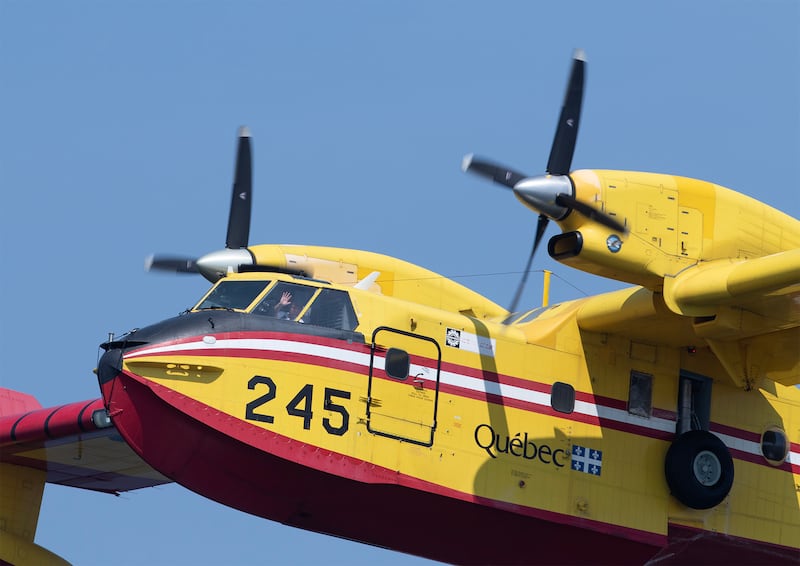
Canada deployed more than 400 firefighters to the United States in 2018, over 590 personnel in 2020, and 250 firefighters and incident management personnel in 2025, according to the spokesperson. Canada also sent ships, helicopters and supplies to help with the rescue and rebuilding when Hurricane Katrina struck in 2005.
The support goes both ways – in 2023, over 2,000 American firefighters were deployed to Canada to aid in the wildfire fight. “As long as they need us, we will continue to help Canada’s firefighters,” Jeff Arnberger, chair of the National Multi-Agency Coordinating Group at the U.S. National Interagency Fire Center, said at the time.
Though last month, Canada’s domestic wildfire response came under scrutiny south of the border after uncontrolled blazes struck several communities in northern Ontario. Smoke from those fires wafted into several northern American states, deteriorating air quality and drawing the ire of politicians there.
At the time, U.S. President Donald Trump accused Canada of “willful negligence” and said the “cost of this pollution” should be added to tariffs imposed on Canadian goods. The White House has yet to impose any trade action to that end.
Canadians’ assistance to the U.S. is not limited to natural disasters. After Sept. 11, Canadians sheltered thousands of stranded airplane passengers in Gander, N.L., opening their homes to Americans while planes were grounded after the terrorist attacks.
And during the 1979 Iran hostage crisis, where American diplomats were captured by the Iranian Revolutionary Guard, Canadian diplomats helped six Americans escape using Canadian passports.
Methodology
Nanos conducted an RDD dual frame hybrid telephone and online random survey of 1,104 Canadians, 18 years of age or older, from July 28 to 30, 2026 as part of an omnibus survey. The sample included both land- and cell-lines across Canada. The results were statistically checked and weighted by age and gender using the latest Census information and the sample is geographically stratified to be representative of Canada. Individuals randomly called using random digit dialling with a maximum of five call backs. The margin of error for this survey is ±3.0 percentage points, 19 times out of 20.

