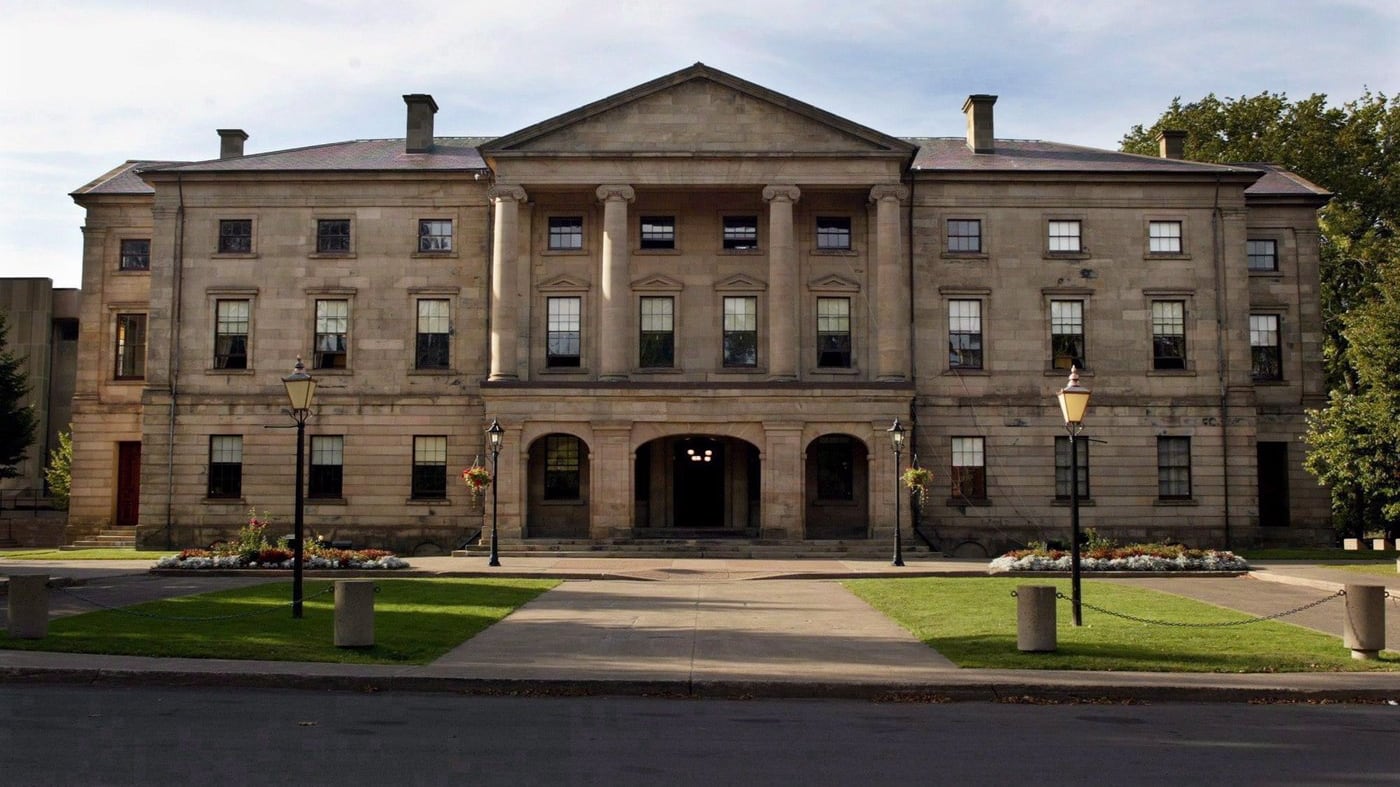
CHARLOTTETOWN — The historic provincial legislature in Charlottetown officially reopened Saturday after a painstaking, much-delayed restoration that took more than a decade to complete.
“The building is an iconic landmark in P.E.I. and it’s been closed for the last 12 years,” Joey Jeffrey, clerk of the legislative assembly, said in an interview Saturday after about 2,000 people showed up to have a look at the renovations.
“The restoration project was very much about preserving the heritage character of the building .... Every stone and every piece of wood in this building has been touched and either cleaned or replaced. The stonework was very challenging work.”
The neo-classical building, known as Province House, opened for its first legislative session in 1847, making it the second-oldest legislature in Canada. Nova Scotia’s legislature in Halifax was completed in 1819.
Prince Edward Island’s legislature is best known as the site of the negotiations -- and raucous, late-night revelry -- in September 1864 that led to the founding of Canada as a self-governing dominion three years later.
Jeffrey said the timing for the reopening couldn’t have been better.
“There’s a real sense of national pride right now,” he said. “I hope Canadians come and stand in the Confederation chamber and reflect on ... those conversations, the first buds of ideas that started this country.”
Also known as the Birthplace of Confederation, the 179-year-old building on Richmond Street has undergone several rounds of upgrades and conservation work over the years. But in February 2014, a report from an engineering firm made it clear that major work was needed.
The report revealed the building’s foundation was crumbling and part of it could collapse. As well, the roof was leaking, intricate masonry was deteriorating and its plaster walls and ceilings were peeling.
“The reports that were coming in before we moved out described a building that was held together by gravity and friction,” Jeffrey said. “The mortar that held the stones together on the inside walls had dissolved over time because of water infiltration.”
In 2015, the building was closed for repairs and the legislative chamber was moved to the nearby Honourable George Coles Building.
The original plan was to complete the renovations within three to five years.
But the project encountered plenty of challenges, including delays caused by the COVID-19 pandemic, supply-chain issues, inflated material costs and a shortage of skilled tradespeople.
“Anyone who has owned an old house and done renovations knows that you really don’t know what you’re getting into until you open up the walls,” Jeffrey said.
Parks Canada, which has been responsible for maintaining the national historic site since 1974, announced in 2023 that the “total investment for long-term preservation” was pegged at $138 million.
Aside from major repairs to the masonry and plasterwork, the project included interior painting, window restoration and other heritage woodwork, new flooring, a new elevator and upgrades to plumbing, electrical, ventilation and fire and safety systems.
The plans also called for installation of a “geothermal wellfield” for heating and air conditioning and a “multi-perspective visitor experience.”
But one of the biggest changes to the building can be found in the basement, where the floor was lowered by 1.5 metres to make way for a staff room, locker room, file storage and a fully accessible washroom.
“It’s no longer the dungeon that it was,” Jeffrey said.
This report by The Canadian Press was first published Oct. 24, 2026.
By Michael MacDonald in Halifax

