Alberta’s health workers who responded to the deadly fire at CFB Wainwright and continue to help its survivors have been formally recognized for their expedient and life-saving efforts.
Representatives from the health agencies overseeing Alberta’s hospital and acute care systems spoke to media in Edmonton Thursday morning, five weeks after those systems were challenged in a way they hadn’t yet been.
“An event of this scale tests every part of the health system, and our system held under pressure. Not because of one hospital or one team, but because hundreds of people across Alberta pulled together in the same direction,” said Acute Care Alberta’s interim CEO Dr. Sayeh Zielke.
“To every member of our health-care teams and to our partners who have stepped forward when they were needed most: thank you. You’ve made an extraordinary difference during an incredibly difficult time, and to our patients and their families, please know that our commitment to their care and recovery remains unwavering,” added Michael Suddes, Alberta Health Services’ interim chief operating officer for the Edmonton health region.
The military says a windstorm drove a nearby grass fire onto troops during a training exercise at the armed forces base around 3 p.m. on Oct. 17.
To date, five soldiers have died from their injuries, while 38 survived.
According to Zielke, as soon as the acute care system received notification of the event, a provincewide committee consisting of every provincial health organization was struck, which established an incident command centre and emergency coordination centre to oversee the response.
0 of 3
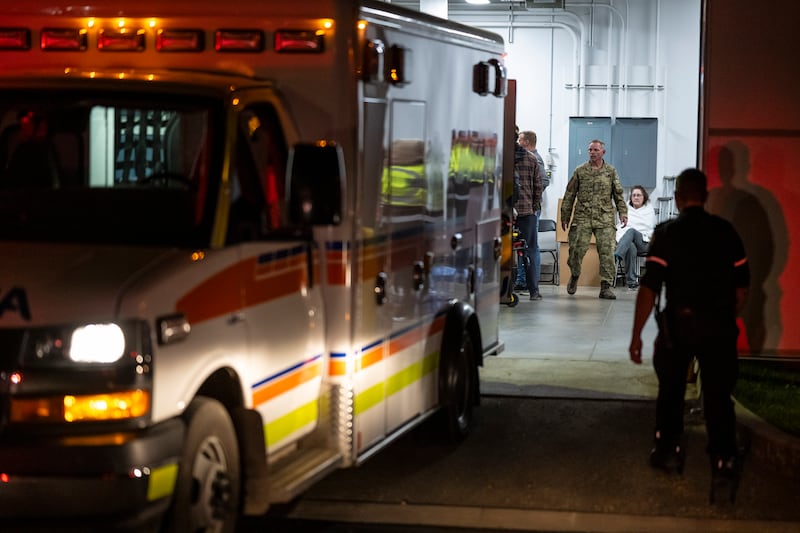
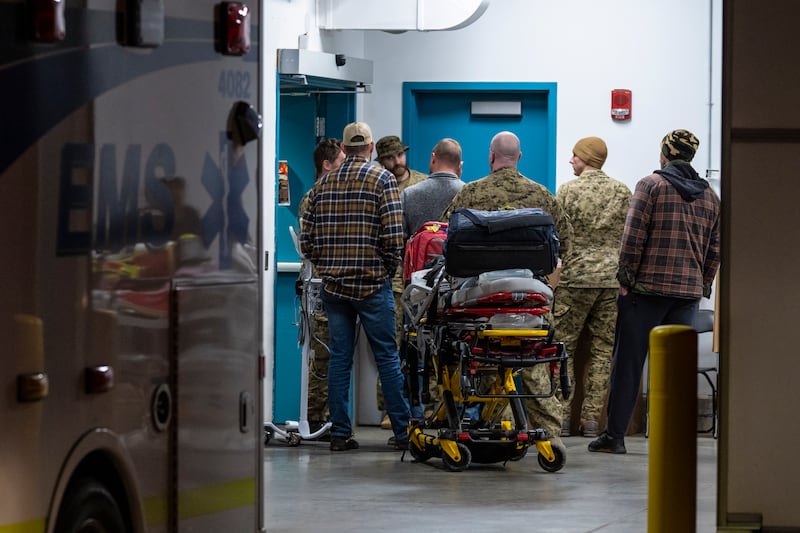
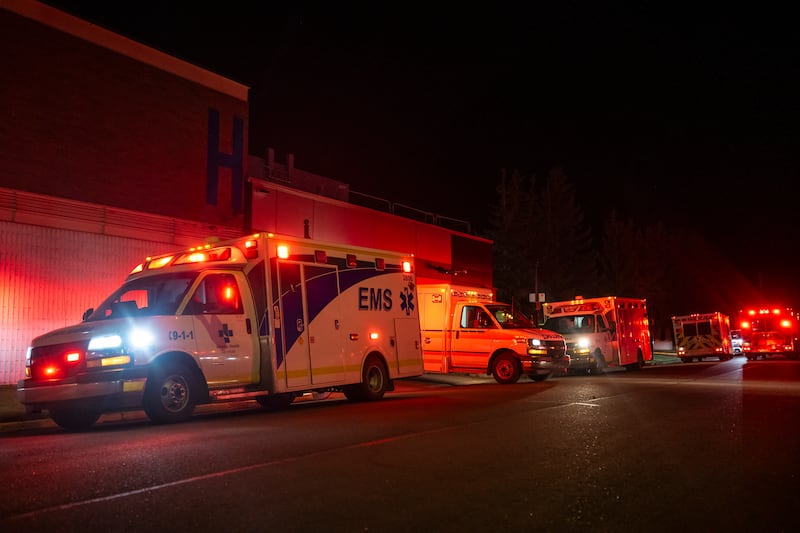
In total, 30 emergency health services units – 22 ground ambulances, six fixed-wing aircrafts and two rotary-wing aircrafts – were dispatched to Wainwright, 200 kilometres southeast of Edmonton, with the task of carrying survivors to the most appropriate hospital for treatment once they were stable. This took until about 3 a.m., Zielke said.
A code orange – or, a mass casualty protocol which triggers a request for extra staff and resources – was called at four hospitals that would receive patients: the University of Alberta and Royal Alexandra hospitals in Edmonton, Red Deer Regional Hospital Centre, and Foothills Medical Centre in Calgary, 400 kilometres away from Wainwright.
“We’ve probably had about half a dozen responses over the last five years that are anything as significant as this, but it’s been some time since we’ve had a cold orange response that’s as large as this and required a full provincial mobilization,” Suddes said.
Because the U of A Hospital is one of few Canadian burn units that is accredited by the American Burn Association, many of the most severely injured soldiers were transferred there.
Typically, the unit has four intensive care beds and four high-intensity care beds, the latter for patients who no longer need the intensive care unit (ICU) but still need a high level of care.
On Oct. 17, the U of A burn unit admitted 20 critically ill patients from CFB Wainwright. At the time, it had already been providing care to 15 burn patients.
The burn unit’s high-intensity beds were prepared for intensive care patients, and the neighbouring ICU moved any patients it could to make room.
“We suddenly had to now resuscitate and do the initial procedures for a multitude of patients all at once, and so we needed to expand our team in order to do that,” recalled Dr. Josh Wong, a burn and plastic reconstructive surgeon and the interim medical director of the Edmonton Burn Treatment Unit at the U of A, who Suddes introduced as one of the tragedy’s “hundreds of heroes.”
As of Tuesday, 19 soldiers were still being cared for in Alberta hospitals, with seven in critical condition. Two others were in hospitals in B.C. and Ontario, closer to family.
Due to patient and military confidentiality, little has been said about the extent of the survivors’ injuries beyond that their “severity is high” and requires intensive care. On Thursday, Wong declined to say whether all of the survivors were conscious and aware.
He said they face a long physical and psychological recovery.
“The psychological component, even in a small burn, can be significant,” Wong told reporters.
In addition to the extra resources offered by the military, other provinces, and other hospital units, his team received on-site psychological support for three weeks following the event.
“We know very well that as the weeks and the months go on, there will be some effects: there will be some fatigue, there will be some psychological effects of these injuries and seeing all of this coming at once, which (we) are not normally used to seeing, thankfully. So we’ve been preparing,” Wong said.
How Alberta’s health system responded to the fire at CFB Wainwright is still being reviewed for learnings, but Zielke said it performed as designed.
“When health care was refocused in this province, the goal was simple: A system where every part knows its role and every part works together to do what is best for the patients,” she said, referencing the 2025 dismantling of Alberta’s single health authority into a four-pillared system.
“On Oct. 17, that is exactly what happened. From paramedics in the field, to the rural hospital teams in Wainwright, air transport crews to specialists in urban hospitals, no one acted as a member of a separate organization. Instead, everyone acted as one team with one goal: getting every patient the right care in the right place as quickly as possible.”
Suddes said debriefings would continue for another two weeks.
“Our commitment is to these patients that we’re currently caring for, but our commitment is, as a system, to keep learning and always improving. I think our initial review is that the response was really phenomenal, but there’s always ways to think about: Can we go a little bit quicker? Can we be even more coordinated?” he told reporters.
Three investigations are looking into the incident at CFB Wainwright.
With files from CTV News Edmonton’s Nahreman Issa

