Padel, a Mexican racquet sport played in doubles, might just be the sport of the summer.
“The resurgence of the game we love has started in Canada, and it’s not going to stop any time soon,” Roberto Alongi wrote on the Canadian Padel Federation’s website. ”We are proud of being part of this big movement, indeed an exciting time for Canadian padel.”
Bill Stamile, who brought padel to Canada in 1992, told CTVNews.ca on Friday that the sport was growing not just in Canada, but across the world.
He said the first padel court in Canada was in Calgary, adding there are now clubs across the country.
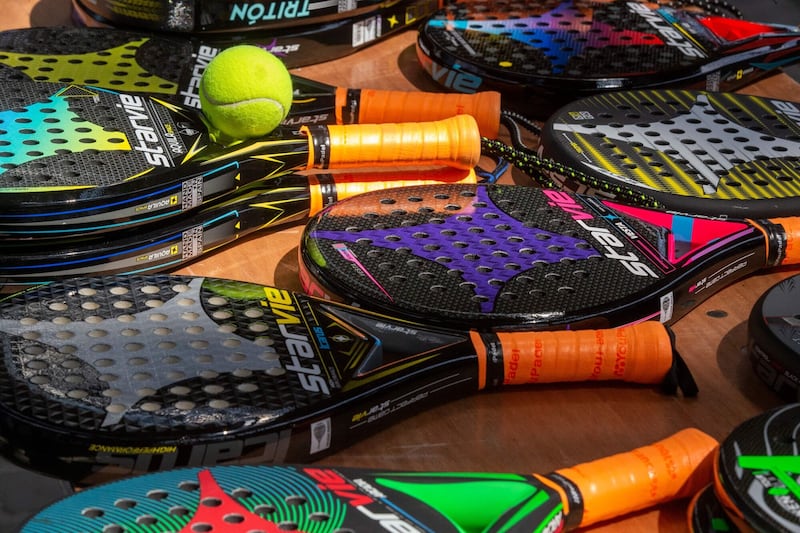
Can Canadians compete?
Canada, Stamile says, is an outlier on the world padel scene, which has largely been dominated by Hispanic countries. He highlighted the Canadian junior boys team finishing third at the 2009 World Cup in Seville, Spain.
“Some people liken that to the Jamaican bobsled team winning a medal,” Stamile said. “Spain, Brazil, Argentina, Argentina, Spain, Canada. And so, people do a double take.”
Padel was invented in Acapulco, Mexico by Enrique Corcuera, who Stamile calls a “tennis fanatic.” The sport is played on a 20-by-10-metre court with a tennis net and surrounded by three-metre-walls. Stamile says it’s a game that relies more on angles and patience than pure power, likening it to chess.
“One of the reasons that it’s taken off all over the planet is it’s very easy to pick up,” Stamile said, adding that the game is built so players of differing skill levels can still compete against one another. He offered his own example, saying he plays with Canadian national team members, adding “not that I have any business doing so.”
Building up the padel player population in Canada is hindered by infrastructure challenges, Stamile said.
“You still have to put the courts up, you still have to put a building up, you still have to heat the building, electric and everything, (along with) taxes,” he said. “It’s a lot more expensive to do the infrastructure needed for the sport to grow than it would be in a Caribbean country or just about anywhere.”
Stamile is hoping for more television coverage of the sport, highlighting that the matches can be played in glass courts, allowing spectators to watch games from all angles. He’s hoping for more big names to get involved, as Serena Williams did earlier this year.
“It just spilled right over to us here and it’s catching a lot of wind,” he said.
Canadian’s interest in the game has been steadily building since 2020, according to Google Trends data, and there are courts across Canada.
The Canada Padel Federation lists clubs in Vancouver, Toronto, Montreal and Edmonton, with multiple venues in major cities. Calgary holds the honour of having Canada’s first padel court, put together by Stamile himself.
“And of course, paddle players have a horrible habit of after they finish playing a match, they hang around and they talk to each other and have some fun afterwards,” Stamile added.
“It’s social, it’s easy to learn, it’s a family game,” he said. “It’s a lifetime sport.”
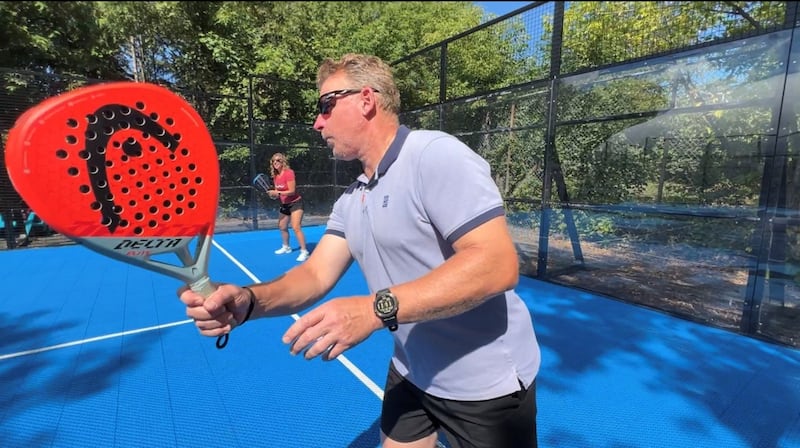
‘Padel is here to stay’
The game spread throughout the Spanish-speaking world when Spanish prince Alfonso de Hohenlohe-Langenburg built courts in Andalusia, Spain. Julio Menditeguy, a friend of Corcuera’s, brought it down to Argentina. Later, Stamile brought it to Calgary from Argentina, where he was born.
He said that because the game uses an underhand serve and short steps, rather than long lunges like tennis, it’s easy to learn but hard to master, making it a good challenge with lots of opportunities for new players to score.
“When I was much younger, more agile, I used to chase the ball,” Stamile, who has been playing for more than 30 years. “But now I’m not so agile. So what I do, I let the wall work for me. So if somebody hits the ball and I’m not comfortable hitting it back to them, I just stand back, it’ll bounce, hit the wall and come right back at me and I keep it alive again.”
Stamile says courts are easy to set up and the game has been blowing up around the world.
“It’s just exploded. It’s ridiculous,” he said about the sport’s growth in the Middle East. He added India had similar growth where it “went kaboom on them.”
“I think whether we like it or not, padel is here to stay.”

