


The Canada-U.S. trade war is entering a new phase, with international media turning its attention to the economic fallout and the threat of further escalation.
After trade talks between Prime Minister Mark Carney’s government and U.S. President Donald Trump’s administration collapsed late Friday, new 50 per cent U.S. tariffs on about $28 billion worth of Canadian goods took effect.
Trump has now threatened additional 50 per cent tariffs on Canadian vehicles, auto parts and steel, while Carney says Canada will not accept what he describes as U.S. demands for subordination.
The latest media coverage reflects growing concern over the impact on the deeply integrated auto industry and the wider economic relationship between the two countries.
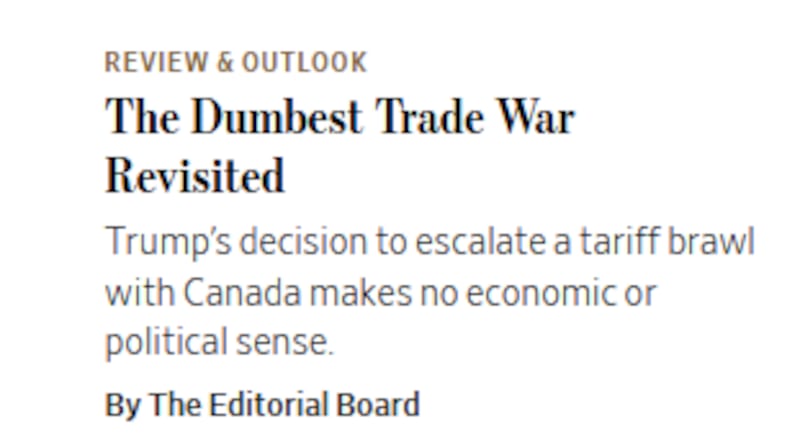
‘The dumbest trade war in history’: The Wall Street Journal
The Wall Street Journal’s editorial board takes a sharply critical view of Trump’s latest escalation, revisiting its previous description of the Canada-U.S. tariff fight as “the dumbest trade war in history.”
The editorial also questions why the Trump administration refused to ease tariffs on heavy- and medium-duty trucks, including those made at Ford’s plant in Ontario.
“Why is Mr. Trump punishing Ford, America’s largest auto producer?” it said.
The Journal also raises the political risks for Trump, noting that the latest escalation comes just 10 weeks before the U.S. midterm elections.
“One reason for Mr. Trump’s frigid approval rating is that voters believe Mr. Trump is waging blunderbuss wars without a strategy, and on trade they’re right,” it said.
‘Americans and Canadians will all lose’: The Washington Post
The Washington Post’s editorial board takes a similarly critical view of the latest escalation, arguing that Trump’s new 50 per cent tariffs would hurt U.S. manufacturers and raise prices on both sides of the border.
It also takes aim at Trump’s treatment of Canada, saying he treats allies worse than adversaries.
The editorial does, however, struck a hopeful chord, saying the delayed Jan. 1 implementation at least leaves time for negotiators to find a way to “disarm an economic land mine.”

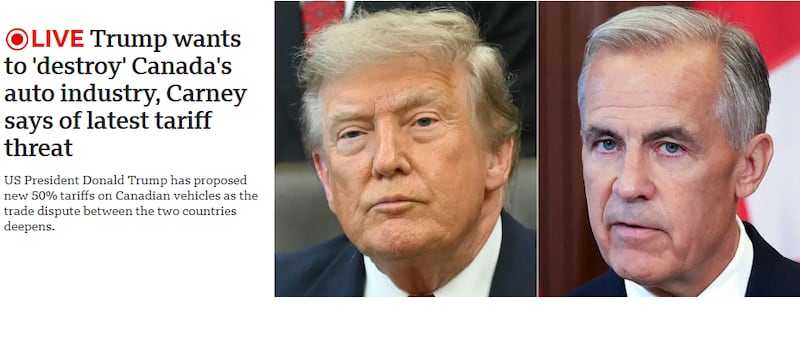
BBC focuses on Trump’s auto tariff threat
The BBC’s latest coverage focuses on Trump’s threat of 50 per cent tariffs on Canadian vehicles, and Carney accusing the U.S. president of wanting to “destroy” Canada’s auto industry.
The BBC also highlights some of the more unusual products caught by the new 50 per cent tariff, noting that the list goes well beyond common imports such as dairy products, plants and plywood. Among the more unexpected items are fake beards and bookbinding machines, underscoring the wide range of Canadian goods affected by the new duties.
The BBC’s earlier coverage on Sunday put Trump’s longstanding suggestion that Canada could become the “51st state” near the centre of the story.
Its headline “Trump says Canada wants ‘benefits’ of being U.S. state after trade talks collapse” underscored the increasingly personal and political nature of the dispute.
The report also emphasized the uncertainty surrounding the next steps, noting that the collapse has upended a deeply integrated trading relationship with no clear path to a resolution.
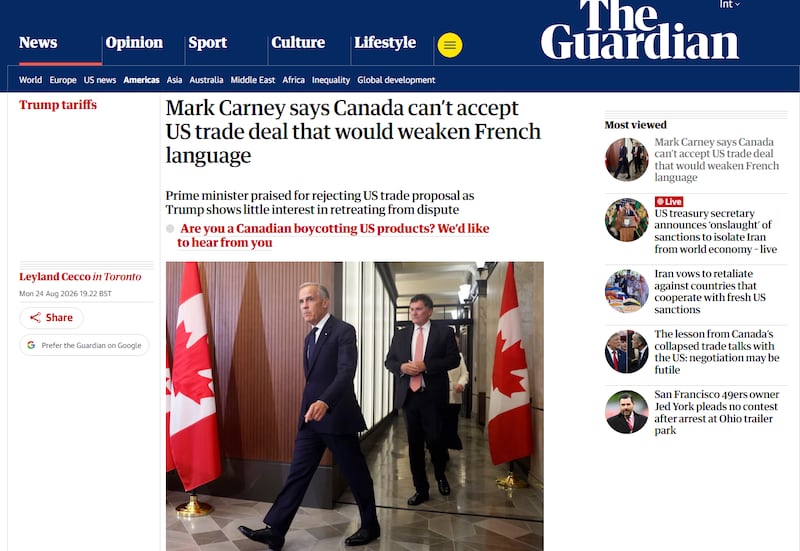
The Guardian highlights French-language protections and auto tariffs
The Guardian’s latest coverage focuses on Carney’s rejection of a U.S. trade proposal that he says threatened protections for the French language in Quebec.
Its headline, “Mark Carney says Canada can’t accept US trade deal that would weaken French language,” frames the dispute as extending beyond tariffs into questions of Canadian cultural sovereignty.
The story says Carney described French-language protections as a fundamental right and non-negotiable, while U.S. Trade Representative Jamieson Greer dismissed claims that the issue was part of the negotiations.
The Guardian’s coverage on Sunday, took a more confrontational approach, framing the dispute as a full-blown trade war.
Its headline, “‘No more!!!’: Trump lashes out after US-Canada talks devolve into trade war,” emphasized Trump’s angry response and the escalation in tariffs.
The Guardian also focused on the symbolism of the new duties, noting they impact an assortment of Canadian goods, from hockey sticks to tongue depressors.
Like the BBC, it pointed to the potential threat to the Canada–United States–Mexico Agreement (CUSMA), suggesting the dispute could extend well beyond the immediate tariff fight.
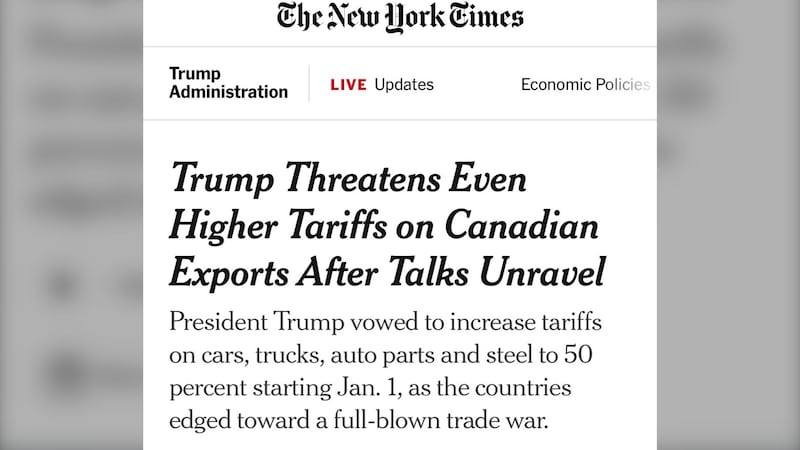
New York Times warns of ‘full-blown trade war’
The New York Times’ latest coverage focuses on Trump’s latest tariff threat, describing the move as pushing the two countries closer to a full-blown trade war.
The story highlights Trump’s increasingly hostile rhetoric toward Canada, including his claim that Canada would no longer be treated like a state and his warning that the consequences would be “far worse” if Canadian officials did not “fall in line.”
The New York Times’ earlier analysis took a different angle, centring its coverage on Carney’s decision to walk away from what he considered an unacceptable deal.
Its headline, “Carney stands up to Trump in trade war despite the risks,” presented the prime minister’s position as both a political stand and a potentially costly gamble.
It noted that many Canadians support Carney’s approach, while warning that the economic consequences could be significant.
That framing put the focus not only on the dispute itself, but also on the risks involved in Canada’s decision.
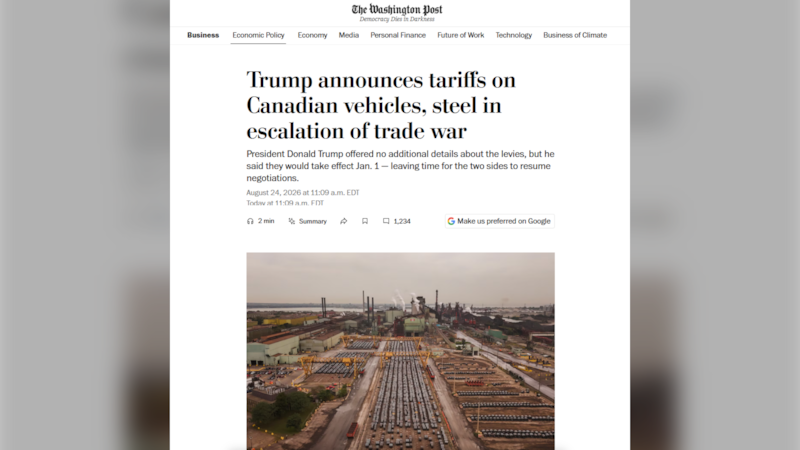
The Washington Post sees auto tariffs as a new escalation
The Washington Post’s latest coverage focuses on Trump’s new auto tariff announcement, presenting it as a fresh escalation in the trade war.
The Post also highlights the economic integration between the two countries, pointing to U.S. reliance on Canadian resources and Canadian reliance on the U.S. market. The report suggests those connections could make the tariffs costly on both sides of the border.
On Sunday, The Washington Post took a broader look at the implications for Trump’s trade policy.
Its headline, “U.S.-Canada breakdown shows limits of Trump’s aggressive trade strategy,” suggested the collapse could demonstrate the limits of using tariffs and pressure to force trading partners into agreements.
The Post also described the breakdown as a setback and noted that other countries that were unhappy with their trade relationships with Washington could be watching at how Canada responds.
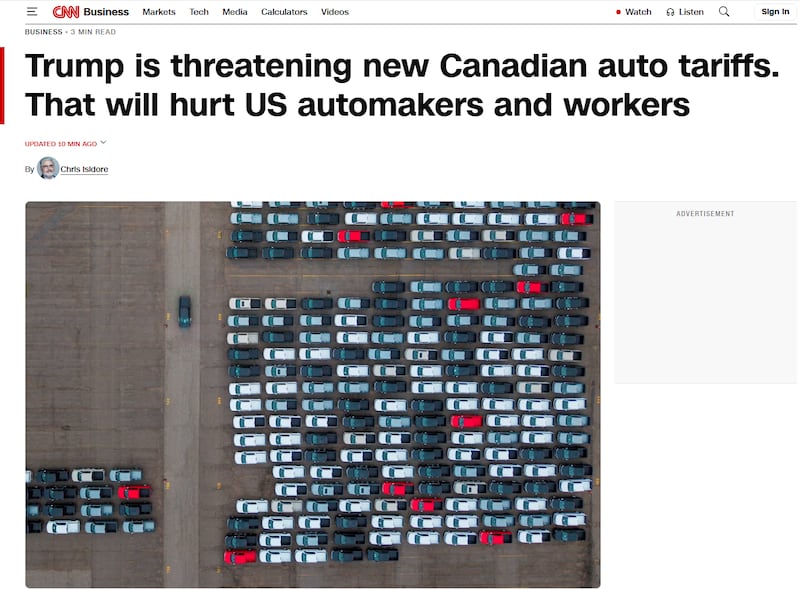
CNN: New auto tariffs could hurt U.S. workers
CNN’s latest coverage examines the potential economic fallout from Trump’s threat of tariffs on Canadian vehicles and auto parts, warning that the measures could hurt U.S. automakers and workers as well as Canadian producers.
The report says the North American auto industry has been rattled by shifting trade rules since Trump returned to office.
In its Sunday coverage, CNN focused on Prime Minister Mark Carney’s claim that Washington demanded too much while offering too little in the failed trade negotiations.
The report highlighted his pledge to impose “dollar-for-dollar” tariffs on about $28 billion worth of U.S. goods, covering products including steel, dairy, appliances, agricultural equipment, pulp, paper and electronics.
The story also laid out the competing positions.
Carney said the U.S. had proposed “uneconomic” and “unfair” terms, particularly around key industries such as autos.
U.S. Trade Representative Jamieson Greer, meanwhile, said Canada had walked away from an agreement that would have delivered major tariff reductions.
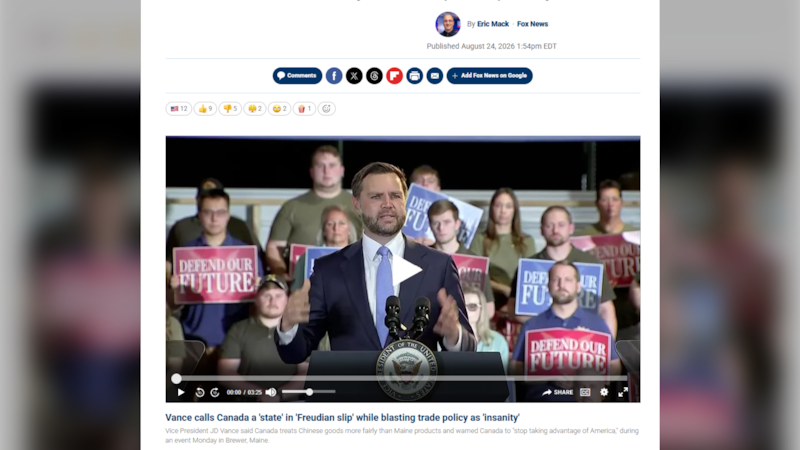
Fox News: Vance accuses Canada of favouring China
Fox News’ latest coverage centres on U.S. Vice-President JD Vance’s accusation that Canada is friendlier to China on trade than it is to the United States.
Vance called the situation “insanity” and pointed to Canadian tariffs on U.S. dairy products while arguing that Ottawa was more accommodating toward Chinese goods.
On Sunday, Fox News framed the collapse through the U.S. administration’s position, highlighting U.S. Trade Representative Jamieson Greer’s claim that Canada rejected “the best deal” Washington had offered.
Greer said the U.S. had been prepared to reduce tariffs on Canadian steel, autos and lumber, but accused Ottawa of choosing to preserve trade barriers against American goods. He said the administration’s focus was protecting U.S. workers and supply chains.
The report contrasted with Carney’s remarks that Washington had made unfair last-minute changes. It also highlighted Greer’s remarks that no new trade talks are currently scheduled, suggesting the dispute could remain unresolved as both countries move ahead with retaliatory measures.
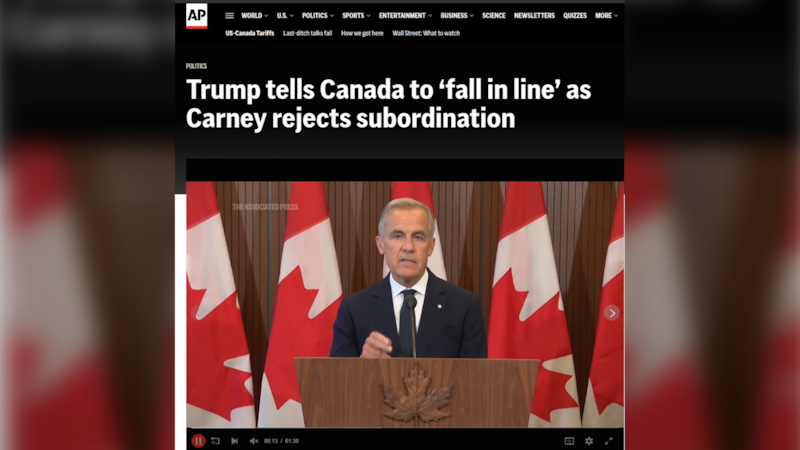
AP: Trump tells Canada to ‘fall in line’
The Associated Press’ latest coverage focuses on Trump’s increasingly confrontational rhetoric toward Canada.
Its headline, “Trump tells Canada to ‘fall in line’ as Carney rejects subordination,” reflects Trump’s increasingly confrontational stance, as he warns Canadian leaders of consequences that would be “far WORSE” than the tariffs already imposed.
AP reports that Carney, meanwhile, rejected what he characterized as U.S. demands for Canadian subordination and said Canada would continue to negotiate from a position of sovereignty.
The story also highlights the potential impact on the deeply integrated North American auto sector and the increasingly forceful responses from Canadian political leaders.
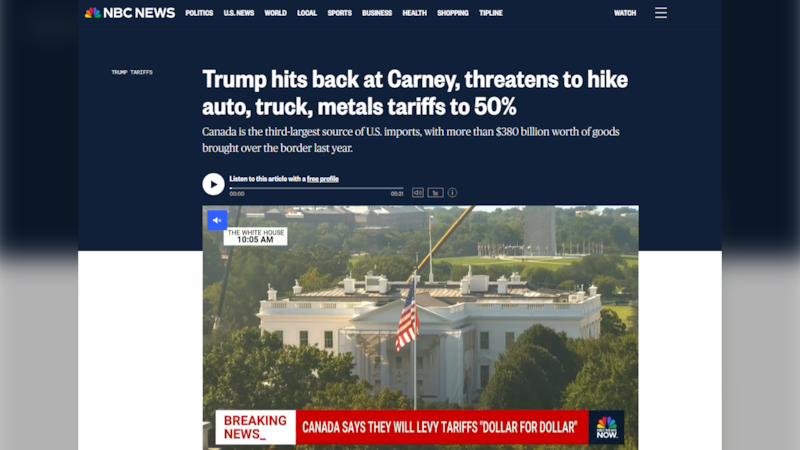
NBC News: Auto and steel tariffs escalate trade fight
NBC News’ latest coverage focuses on Trump’s tariff threat, describing it as another escalation in the trade dispute.
The report puts the auto industry at the centre of the latest confrontation, as the new tariffs threaten a highly integrated manufacturing sector that spans both countries.
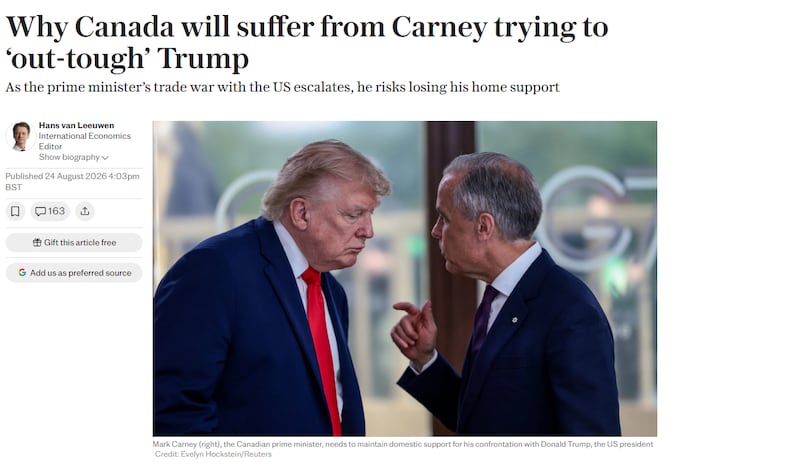
The Telegraph: Canada risks economic pain
The Telegraph takes a more critical view of Carney’s approach in its latest analysis, “Why Canada will suffer from Carney trying to ‘out-tough’ Trump.”
The story argues that Carney risks economic damage by taking a harder line against Trump and suggests the prime minister could face domestic political consequences if the trade conflict continues to escalate.

